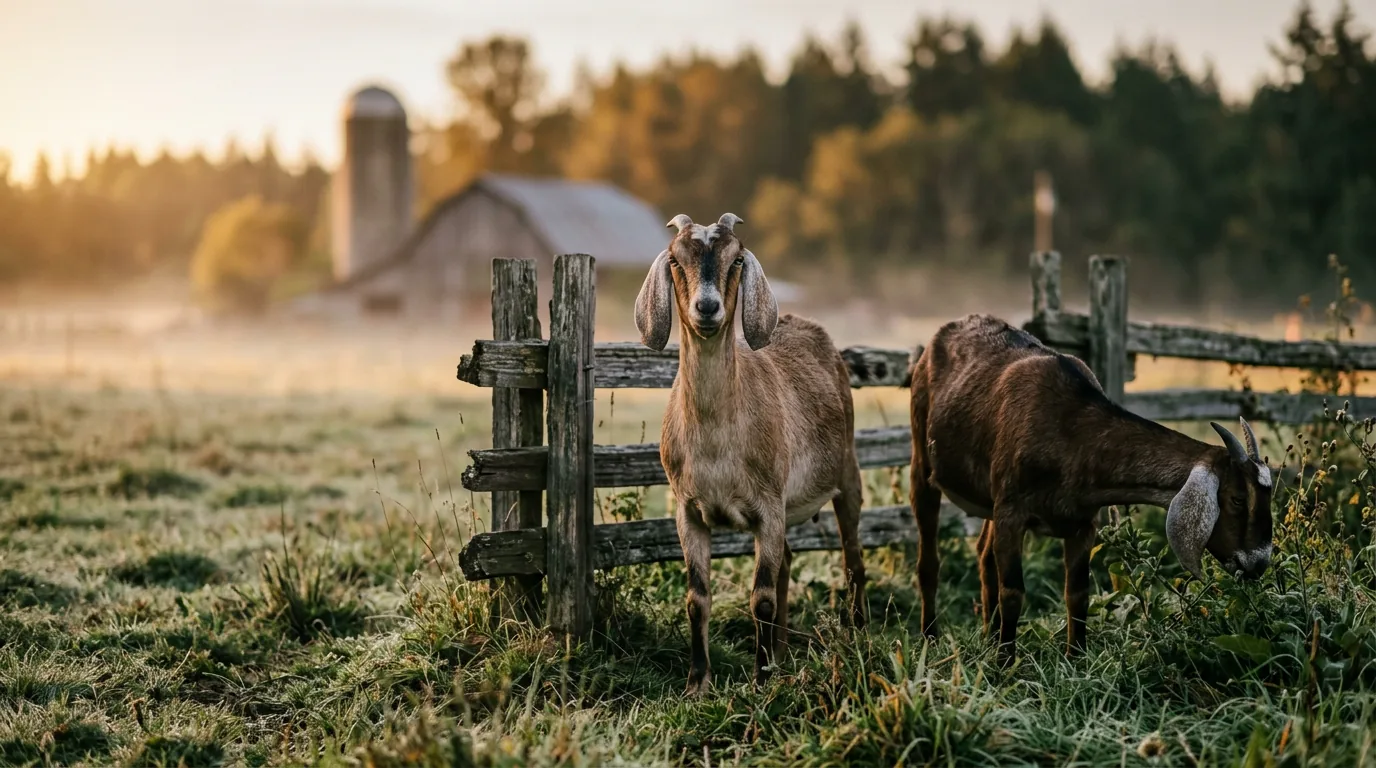
🐐 Raising Goats: A Practical Guide
Dairy goats for families — breeds, fencing (they WILL test it), milking rhythm, and honest costs.
Dairy goats for families — breeds, fencing (they WILL test it), milking rhythm, and honest costs.
Overview
Goats are versatile small ruminants kept for milk (dairy breeds like Nigerian Dwarf, Nubian, Alpine), meat (Boer, Kiko), fiber (Angora, Cashmere), or brush clearing. They're social herd animals with strong personalities, moderate space needs, and a well-earned reputation as escape artists. They're a step up in commitment from poultry but far more approachable than cattle.
Why It Works
As ruminants, goats thrive on browse (brush, weeds, leaves) more than pure grass, using a multi-chambered stomach to digest rough forage -- which is why they're great for clearing land. Their health hinges on adequate minerals (notably copper, which they need more of than sheep), parasite management (their #1 health challenge), clean water, dry shelter, and regular hoof trimming. Socially, they need herd mates. Dairy goats must be bred to produce milk and then milked on a routine.
What You Get Out of It
- Home dairy (milk, cheese, soap, yogurt).
- Brush, weed, and land clearing.
- Meat production (meat breeds).
- Fiber (Angora/Cashmere).
- Friendly, manageable step-up livestock and companionship.
Key Principles
Proven principles: (1) Keep at least two -- goats are herd animals and suffer alone. (2) Fencing is the make-or-break: build strong, tall, tight fencing before they arrive. (3) Provide free-choice goat minerals with copper (sheep minerals are inadequate/dangerous for goats). (4) Manage parasites proactively (their top health issue) with rotation and monitoring. (5) Give dry shelter, clean water, browse/hay, and regular hoof trims.
Step-By-Step
Step What to do 1. Companions + Get at least two; choose breed for your goal (Nigerian Dwarf/Nubian for milk, Boer for breed meat, etc.).
Build strong, goat-tight fencing (woven wire/electric) BEFORE they arrive -- assume 2. Fence first they'll test it all.
- 3. Shelter & water Provide dry draft-free shelter and constant clean water; goats hate rain and wet.
Browse/quality hay as the base; free-choice goat loose minerals WITH copper; grain 4. Feed & minerals only as needed (e.g., milkers).
Proactive parasite management, annual vaccinations as advised, and hoof trimming 5. Health care every ~6-8 weeks.
- 6. Dairy routine If milking, breed, then milk on a consistent daily schedule with clean technique.
The two things that ruin goat-keeping are keeping a lonely single goat and under-building fences. Solve companionship and containment first; everything else (minerals, parasites, hooves) is routine once those are handled.
Common Mistakes & Cautions
- Never keep a single goat -- isolation causes stress, noise, and poor health.
- Weak fencing = constant escapes and destroyed gardens; goats climb and squeeze.
- Copper is critical -- use goat-specific minerals; sheep minerals can cause copper deficiency.
- Parasites (barber pole worm) are the #1 killer -- monitor and manage proactively.
- Check zoning/ordinances; intact bucks are smelly and need separate management.
Gear & Supplies
- At least two healthy goats from a reputable breeder; breed matched to your goal.
- Strong goat-tight fencing (woven wire and/or electric) built before arrival.
- Goat-specific loose minerals (with copper), quality hay/browse access, clean water setup.
- Hoof trimmers and a basic health/parasite kit; milking gear if dairy.
The FarmFit Take
Goats are the homestead's friendliest step up -- milk, brush control, and endless personality -- but respect the two hard rules: always keep at least two, and build fencing that actually holds them. Give them dry shelter, copper-adequate minerals, parasite management, and hoof care, and goats become one of the most rewarding and fun animals on the place.
REFERENCES
- University Extension goat husbandry guides (housing, fencing, nutrition).
- Cooperative Extension resources on goat minerals (copper) and parasites.
- Dairy goat management and hoof-care basics.
How It All Connects
The next step up from Chickens 101 — real dairy independence with real daily commitment.
Where To Go Next
Goats are lost to two things far more often than anything else: parasites and bad fencing. Goat Parasites and FAMACHA is the single most useful follow-up here — barber pole worm kills more goats than every other cause combined, and FAMACHA scoring lets you treat the animals that need it instead of the whole herd. Fencing That Actually Holds is the other one, because a goat will find the weak spot within a week. If you are keeping does in milk, Home Dairy Basics covers the routine, and Raw Milk, Honestly covers the risks without either the scare stories or the evangelism. For predator pressure, Livestock Guardian Animals; for pasture that does not get wormy and bare, Rotational Grazing on Small Acreage.
Get the printable one-page PDF version — free, straight to your inbox.
Related Guides
Common Questions
What is Raising Goats used for?
Traditionally and in current practice, raising goats is used for goats, milk, livestock, homestead dairy. The sections above cover what the evidence actually supports versus what is traditional use only.
How do I prepare raising goats?
The How To Use It section above covers preparation, form and typical amounts. Preparation method matters more than most people expect — the same plant prepared two ways can behave very differently.
Is raising goats safe?
The Safety and Cautions section above lists the known interactions and contraindications. Safety depends on your own health conditions and medications, so check with your doctor or pharmacist before starting anything new.
How long before raising goats works?
It depends entirely on what you are using it for. Acute uses may act within hours; anything working through the body's regulatory systems generally needs several weeks of consistent use before you can judge it.
Can I use raising goats with prescription medication?
Possibly, but this is exactly the question to ask a pharmacist rather than the internet. Pharmacists check interactions for a living, the consultation is usually free, and herb-drug interactions are genuinely common.
Get the printable version
Download this guide as a clean PDF for your medicine cabinet — plus new guides as they publish.
Educational and informational purposes only. FarmFitUSA content is not medical or veterinary advice and is not intended to diagnose, treat, remedy, or prevent any disease. These statements have not been evaluated by the FDA. Consult a qualified professional before acting on anything here, and call a vet or a doctor when the situation warrants it.